Coilover Setup: Ride Height and Damping for Road and Track
How to set ride height and damping on coilovers for road and track, common mistakes to avoid, and why lowering always needs a wheel alignment.
Published · The Redline Speed workshop team, Sofia
In short: On coilovers, ride height is set on the threaded damper body and stiffness of movement is changed with the damping adjuster. For the road, start from the kit maker's base setting with a moderate drop and softer damping. For the track, add damping gradually, one or two clicks at a time. Every change in ride height must be followed by a wheel alignment at a specialist centre.
How a coilover works
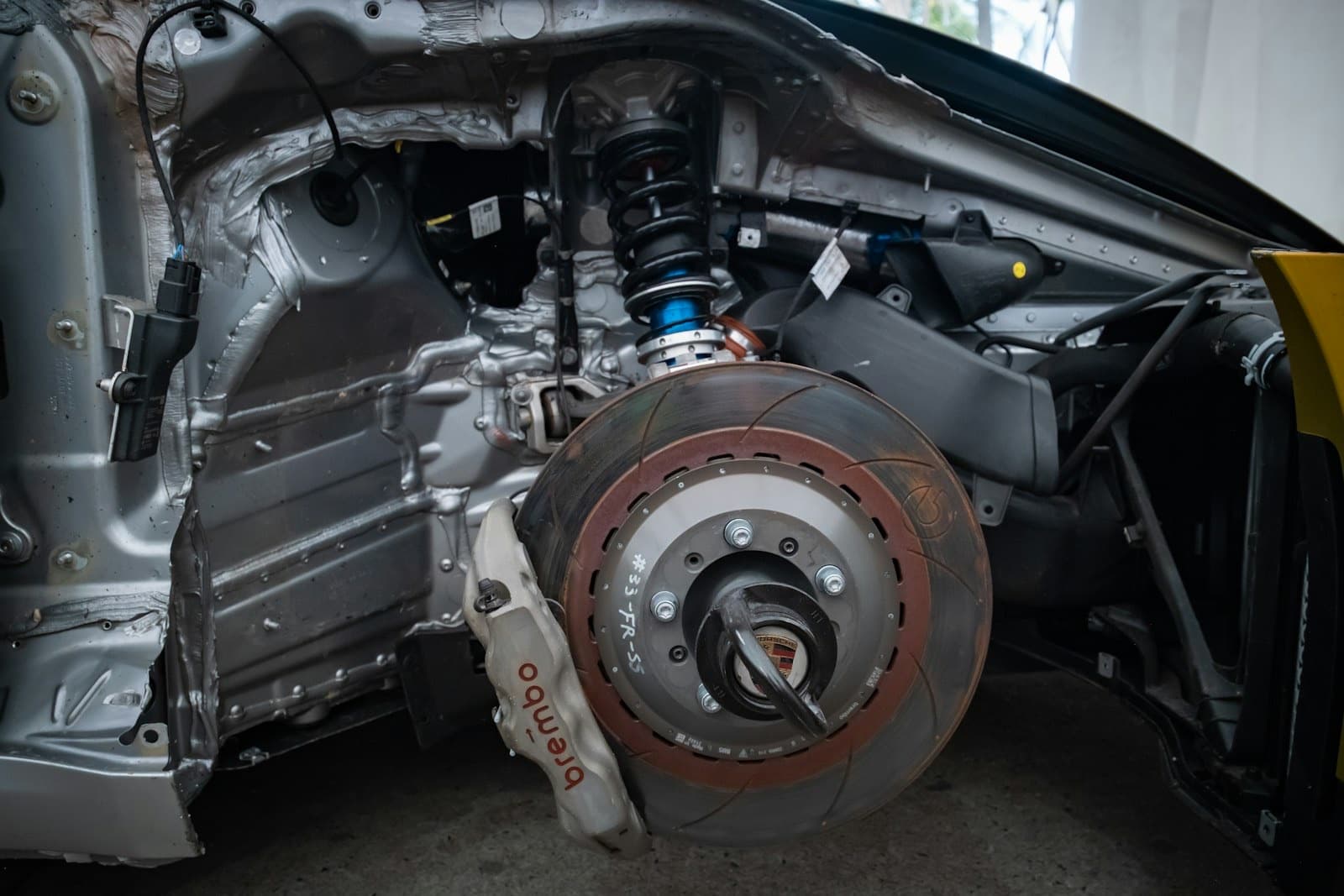
A coilover is a damper with a threaded body and a coil spring around it. Locking collars on the thread set the position of the lower spring seat or, on some designs, the damper's lower mount. Kits differ in what exactly you can adjust.
Two ways to adjust height
- Spring seat adjustment. Simpler kits change height by moving the spring seat up or down. Lowering the car this way leaves the damper the same length, so it works closer to the end of its stroke. Go too low and the suspension hits the bump stop on every sizeable bump.
- Lower mount adjustment (full-length adjustable). The damper body screws into its lower bracket, so height changes without affecting damper stroke or spring preload. This design makes precise setup easier and is more common on track-oriented kits.
Spring preload
Adding preload does not make the suspension stiffer. Spring rate is a property of the spring and preload doesn't change it. On full-length adjustable kits, preload is set to the maker's spec and then left alone; height is adjusted at the lower mount. Some kits also have a helper spring that keeps the main spring seated when the wheel hangs.
Setting ride height
Measure from the hub centre to the edge of the arch at all four corners. The car should be on level ground, with tyres at the correct pressure and its usual fuel load. After each change, drive a short distance to let the suspension settle, then measure again.
- Aim for the same height left to right. A few millimetres is fine; more than that shifts the weight between the wheels.
- Keep enough stroke. If the suspension reaches the bump stop, the tyre loses grip exactly when it is most loaded.
- Check that the tyres clear the arches and suspension parts at full lock and under compression.
- Heavy lowering changes driveshaft angles and suspension geometry. A lower car doesn't automatically corner better.
Suspension bolts that pass through rubber bushes get their final torque with the car on its wheels at final ride height. Tightened with the suspension hanging, the bushes stay twisted and wear quickly. The same goes for adjustable drop links: set their length at final ride height so the anti-roll bar isn't preloaded at rest.
Setting damping
The spring decides how far the suspension compresses under load. The damper decides how fast it gets there. The damping adjuster controls the speed of movement and has no effect on ride height.
Most road kits have a single adjuster that mainly changes rebound, or both directions together on some designs. Track kits often have separate bump and rebound adjusters. Count clicks from full stiff: turn the adjuster gently to its stiff end and count back. Write down the setting at every corner.
Road setup
Start from the maker's road recommendation or the middle of the range. If the car skips over bumps and you feel it through the wheel and seat, soften by two or three clicks. If it floats and keeps moving after a bump, the damping is too soft. On the road you want the tyres to follow broken tarmac, and that needs stroke and softer damping.
Track setup
On track, more damping limits body roll and weight transfer under braking and cornering. Change one setting at a time, one or two clicks, and drive several laps before judging it. As a rule of thumb, a stiffer front adds understeer and a stiffer rear adds oversteer, but the real result depends on tyres, alignment and anti-roll bars, so log every change and how the car felt. If you are building a more serious track car, see our track preparation service.
Symptoms and what to do
| Symptom | Possible cause | What to do |
|---|---|---|
| Car skips and loses grip on bumpy roads | Damping too stiff or car too low | Soften by 2–3 clicks and check remaining stroke |
| Thump from the suspension over bigger bumps | Out of stroke, hitting the bump stops | Raise the car or choose a kit with suitable stroke |
| Knocking from the suspension after fitting | Loose collars, top mount or drop links | Recheck torque with the car on its wheels |
| Car pulls to one side, uneven tyre wear | Toe and camber changed with the new height | Wheel alignment at a specialist centre |
| Different height left and right | Collars set differently or suspension not settled | Short drive, measure again and correct |
Why lowering always needs an alignment
Changing ride height changes the wheel angles. On most suspension designs, lowering adds negative camber and changes toe. Wrong toe is the main reason tyres wear fast on the inner or outer edge and the car pulls to one side.
We fit and set up coilovers in-house. The alignment itself is done at a specialist centre. We can recommend one, or take the car there for you and bring it back ready. The order is: fitting, ride height, settling, final torque and checks, then alignment. If you change the height later, the alignment needs checking again. It is also worth rechecking torque and ride height after the first few hundred kilometres.
Common mistakes
- Lowering until the car sits on its bump stops because it looks better.
- Running full stiff damping all round on a road car "just in case".
- Using spring preload to change height on a full-length adjustable kit.
- Driving without an alignment after new suspension goes on.
- Not writing settings down, so every change starts from scratch.
If you are getting the car ready for the road or your first track day, see our first track day checklist. For coilover fitting and setup, call +359 879 000 708 or book an appointment.