Automatic gearbox fluid: how long does “lifetime” last?
Why automatic gearbox fluid wears out, when to change it and how the job should be done on a conventional automatic and on a DSG.
Published · The Redline Speed workshop team, Sofia
In short: Automatic gearbox fluid wears out with time and heat, even when the carmaker calls it “lifetime” fluid. On conventional automatics, a change every 60,000 to 100,000 km, depending on how the car is used, protects the clutches and the hydraulics. On wet-clutch DSGs the manufacturer sets an interval, and it should be kept. The job needs the fluid specified for the gearbox and a level check at the right temperature.
What “lifetime fluid” really covers
Many carmakers leave the automatic gearbox fluid out of the service schedule. Their calculation assumes a certain mileage and normal use. Most used cars on the market are well past that mileage, and city traffic, mountain roads and towing are all hard work for a gearbox.
ZF, which makes many of the automatics in BMWs, Audis and other brands, recommends periodic fluid changes in its service literature, roughly every 80,000 to 120,000 km or 8 years. That is a sensible guide for gearboxes from other makers too.
What happens to the fluid over time
Automatic gearbox fluid does several jobs at once. It carries the pressure that closes the clutches, lubricates the gears and bearings and takes heat away. It also contains additives that control exactly how the friction plates grip.
As the miles add up, three things happen:
- The additives get used up. The clutches start to grab harshly or slip, and the torque converter lock-up clutch may judder.
- Heat oxidises the fluid. Every spell of overheating in traffic, on a climb or in spirited driving makes it age faster.
- Wear particles build up. They pass through the valve body and wear the valves and their bores.
The change is gradual. Many owners get used to rougher shifts and only notice once a fault appears.
Signs the fluid is worn
- Harsher or slower shifts, especially when cold.
- Judder under light throttle around 60–80 km/h, when the torque converter locks up.
- Revs rising without the car accelerating to match.
- A clunk when selecting D or R.
- A burnt smell from the fluid when it is checked.
Colour is a poor guide. Some new fluids are dark straight from the factory, so we judge condition by smell, contamination and how the gearbox behaves.
How often to change it
Conventional automatics with a torque converter
These include the ZF 6HP and 8HP, Mercedes-Benz 7G-TRONIC and the Aisin gearboxes. For normal driving we recommend a change every 60,000 to 100,000 km. If the car spends most of its time in town, tows a trailer or is driven hard, a shorter interval is better.
Wet-clutch DSG and S tronic
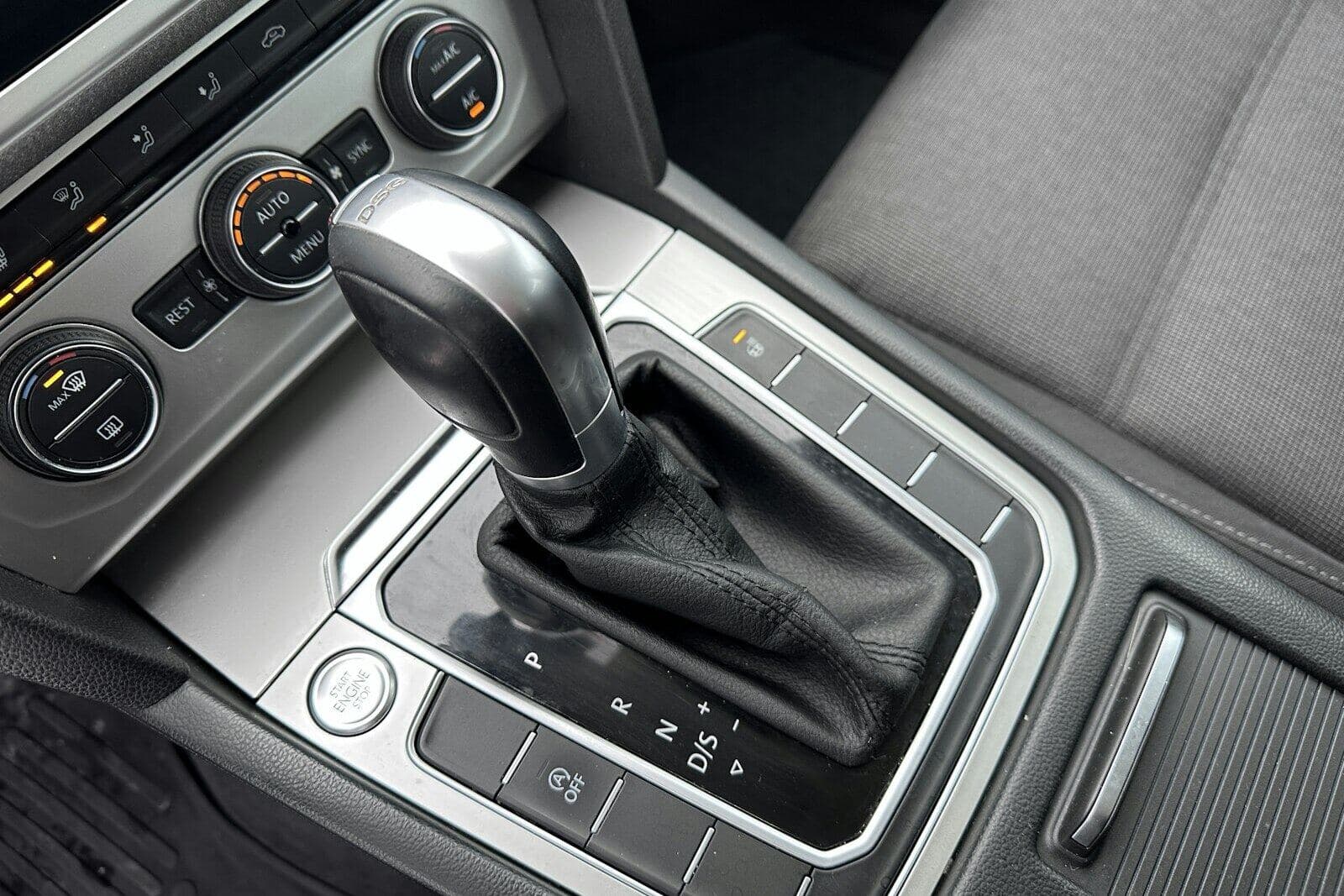
For the DQ250 the manufacturer specifies a change at about 60,000 km. Here the fluid also cools the clutches, so a late change hits the mechatronic unit directly. Our article on DSG and S tronic mechatronic faults describes the symptoms.
Dry-clutch DSG (DQ200)
Here the gear oil and the mechatronic fluid are separate, and the manufacturer specifies no change. At high mileage, or if a leak is suspected, we check the level and condition.
CVTs
Continuously variable gearboxes such as Audi's Multitronic are especially sensitive to the type and condition of the fluid. They need the specific fluid developed for them and regular changes.
How the job should be done
- Fluid to the gearbox specification. A universal “all automatics” fluid can change how the clutches grip. We use the fluid approved for that gearbox.
- Filter and seal. On the ZF 8HP the plastic sump and the filter are one part and are replaced together. Other gearboxes have a separate filter.
- Level check at a set temperature. Most modern automatics have no dipstick. The level is checked at the filler hole with the engine running, at the temperature the manufacturer specifies. Too little and too much fluid both harm the gearbox.
- Adaptation where needed. On some gearboxes the adaptation values are reset after the change, and the module relearns them as the car is driven.
A simple drain only replaces part of the fluid, because the rest stays in the torque converter and the cooler. With badly contaminated fluid, two changes in a row are sometimes done.
High mileage, fluid never changed
People often say that changing old fluid “kills” the gearbox. Fresh fluid does not harm a healthy gearbox. If the clutches are already worn, though, new fluid won't bring them back, and the problem may become more obvious after the change. On a high-mileage car we diagnose first: read the faults, check the adaptation values and road-test. That way you know the gearbox's condition before any work is done.
| Symptom | Possible cause | What to do |
|---|---|---|
| Harsh shifts when cold | Worn fluid, adaptations | Check the fluid and the adaptation values |
| Judder around 60–80 km/h under light throttle | Torque converter lock-up clutch, old fluid | Fluid change to specification and a road test |
| Revs rise without acceleration | Slipping clutches, low fluid level | Stop driving hard and book diagnostics |
| Fluid under the gearbox | Sump gasket, connector or shaft seal | Fix the leak and check the level |
| Clunk when selecting D or R | Fluid, a valve in the valve body, engine mounts | Diagnose before simply changing the fluid |
The same goes for other “lifetime” fluids
Transfer cases and differentials often have fluid with no service interval either. On xDrive, for example, old transfer case fluid is a common cause of judder in tight turns. Our article on BMW xDrive transfer cases explains more.
We change fluid in and repair automatic gearboxes at our workshop in Vrazhdebna. See the automatic gearbox repair page, book a visit or call us on +359 879 000 708.