Car Diagnostics: What a Scan Shows and What It Misses
What a diagnostic scan can read from your car, why a fault code is not a finished diagnosis, and which faults only show up on inspection.
Published · The Redline Speed workshop team, Sofia
In short: A diagnostic scan reads stored fault codes and live data from your car's control units and tells you which system and which circuit is out of range. It rarely names the failed part, and it cannot see mechanical wear that has no sensor. A fault code is where the diagnosis starts; the cause is confirmed with measurements, inspection and a test drive.
What computer diagnostics actually is
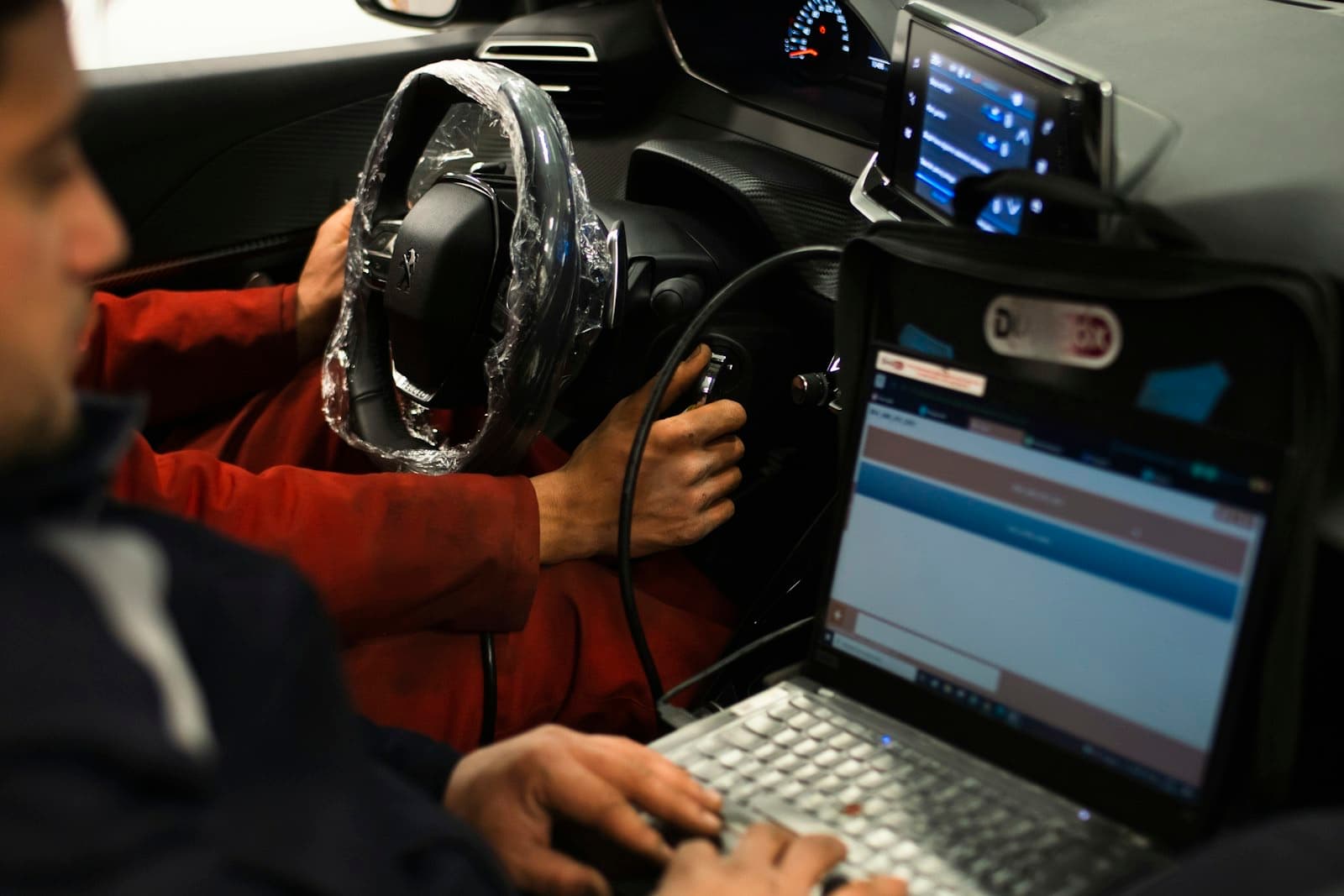
A modern car has anything from a handful to several dozen control units: engine, gearbox, ABS and ESP, airbags, climate control, lighting, comfort systems. Each one monitors its sensors and stores a fault code when a value goes out of range. The diagnostic tool plugs into the standard OBD socket, usually under the dashboard on the driver's side, and reads that information.
EOBD has been mandatory in the EU for petrol cars since 2001 and for diesels since 2004, but it mainly covers emissions-related systems. Reaching the other control units, manufacturer-specific codes and setup functions takes fuller diagnostic equipment. We use diagnostic equipment that covers all makes.
What a scan shows
- Stored and pending faults. Along with the code, the control unit often records how many times it occurred and under what conditions: revs, temperature, speed, mileage.
- Live data. Coolant and oil temperature, fuel pressure, boost pressure, lambda sensor readings, fuel trims, cam timing, gearbox oil temperature.
- Actuator tests. The tool can switch on a fan, fuel pump, valve or relay to see whether it responds.
- Adaptations and setup. Some parts need to be adapted or registered after replacement, such as the throttle body, the battery on many cars, or automatic gearbox adaptations.
- Diesel particulate filter status: soot load and regeneration history.
- Service intervals. Resetting the indicator after a service and, if needed, a forced DPF regeneration.
What a scan misses
- Mechanical wear with no sensor. On most cars, mounts, bushes, ball joints, wheel bearings, dampers and brake discs aren't monitored electronically. They are checked on a lift and on a test drive.
- Leaks and fluid condition. Oil, coolant and brake fluid leaks are found by looking. At most, the electronics report a low level.
- The exact failed part. A code says a value is out of range, not why. More on that below.
- Recently cleared faults. A cleared code no longer shows up. The readiness monitors do reveal that the memory was cleared recently, which is worth knowing when you buy a used car.
- Bodywork and paint. Accident damage, repairs and filler are found by inspection and a paint thickness gauge.
Why a fault code isn't a diagnosis
Take P0171, "system too lean". The engine control unit sees more air entering the cylinders than it expects for the fuel being injected. The cause could be an air leak after the mass airflow sensor, an inaccurate MAF, a weak fuel pump, a blocked fuel filter or dirty injectors. Replace the first item on that list without testing and the code often comes back.
Misfire codes (P0300 to P0306) work the same way. The cause could be a coil, a spark plug, an injector, an air leak or low compression. Swapping a coil between two cylinders and seeing whether the misfire follows it narrows things down quickly, but if compression is low, no coil or plug will fix it.
So after reading the codes comes the real work: analysing live data, measuring voltage, resistance and pressure, and sometimes smoke-testing the intake for leaks. This part takes the most time, and it decides whether the right part gets replaced.
Symptoms that call for a scan
| Symptom | Possible cause | What to do |
|---|---|---|
| Flashing check engine light | A misfire that can damage the catalytic converter | Drive gently and get it checked as soon as possible |
| Check engine light on steadily | Many possibilities: a sensor, an air leak, an emissions fault | Book diagnostics in the next few days; don't clear the code first |
| ABS and ESP lights on | Wheel speed sensor, wiring or a control unit fault | The brakes still work but without ABS; book a check |
| Harsh shifts or the gearbox in limp mode | Low or old fluid, mechatronic unit, lost adaptations | Scan the transmission control unit |
| Noise, vibration or a leak with no stored faults | Mechanical wear that has no sensor | Inspection on a lift and a test drive |
How diagnostics works at our workshop
- We talk through the symptoms: when they appear, hot or cold engine, at what speed, and any recent repairs.
- We read every control unit, not just the engine. A fault in one unit often explains a symptom in another.
- We analyse live data and, if needed, take a test drive while logging values.
- We measure and test the specific components the data points to.
- We explain what we found, what we suggest repairing and what can wait.
Diagnostics is a paid service, since it takes a technician's time and specialist equipment. A quick code read and a proper search for the cause are very different amounts of work, so please describe the symptoms in as much detail as you can when you book.
What if you have your own code reader?
A cheap OBD reader is handy for seeing whether the engine control unit has a stored fault. Most can't reach the other control units or show manufacturer-specific codes. If you clear the fault before bringing the car in, the record of when and how it happened is lost. Write the code down and leave the memory as it is.
When a scan makes sense
- When a warning light comes on, even if it goes out after a restart.
- When the car behaves differently: harder starting, less power, odd gear changes.
- Before buying a used car, as part of a full pre-purchase inspection. Our used car checklist covers what else to look at.
- With automatic gearbox problems, including DSG and S tronic, before deciding on an automatic gearbox repair.
If a warning light is on or the car is behaving oddly, call +359 879 000 708 or book a diagnostic check.